
3 Record Breakingly Old Animals: Jonathan the Tortoise, Wisdom the Albatross & Ming the Clam (#134)

LISTEN TO THIS EPISODE
Listen to or download this episode right here on this page, or find more places to listen below.
More Places to Listen
(Listening on Apple Podcasts or Spotify? Please leave us a quick star rating and/or review - it'd mean a lot!)
About the Episode
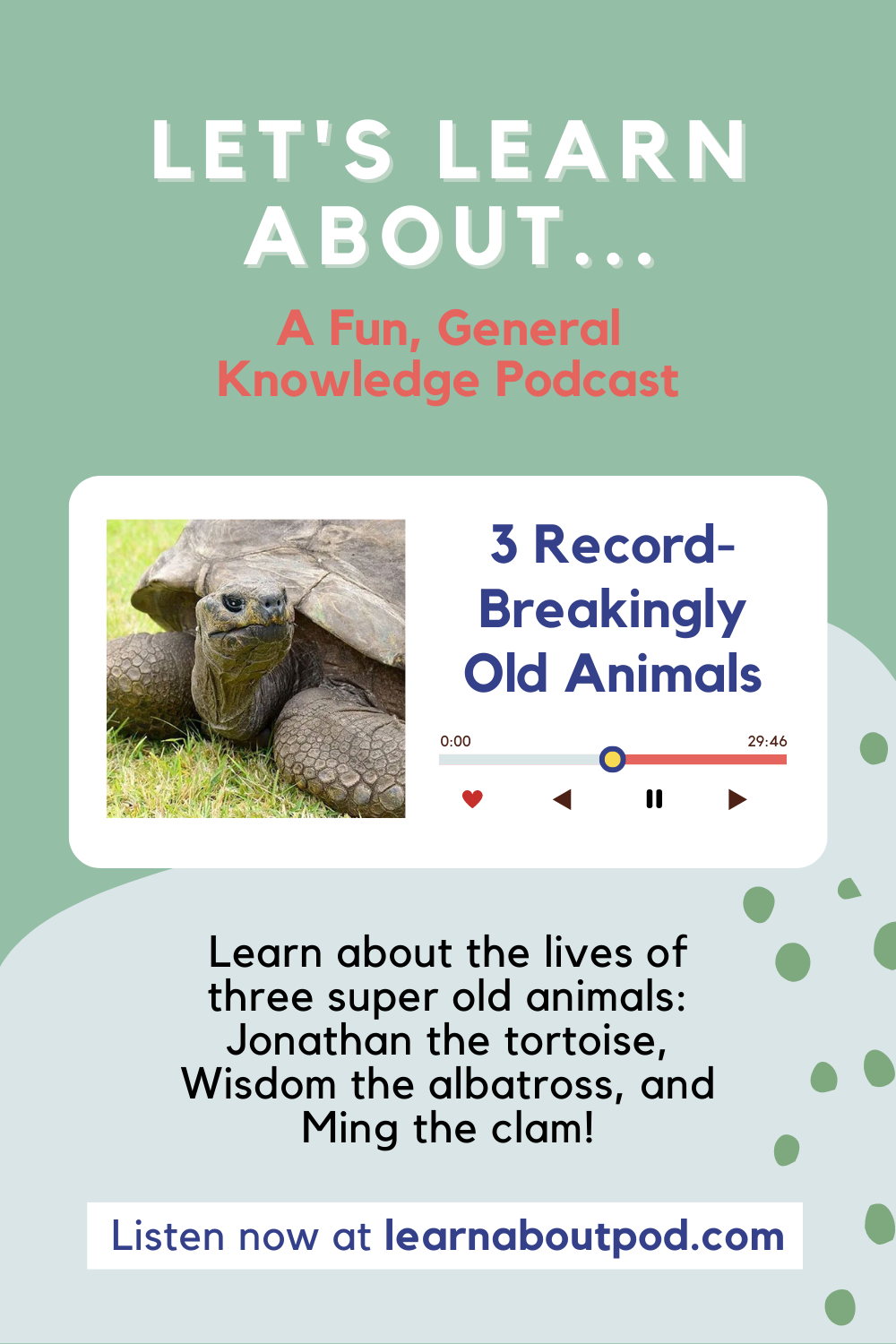
In a random but fun (and kind of wholesome) episode, Charlotte talks about three animals that have broken records for their incredibly old age: Jonathan the tortoise (currently around 190 years old), Wisdom the albatross (currently at least 70 years old), and Ming the clam (who was sadly killed by researchers at the grand old age of 507).
Related episode: 100 Fun Facts to Celebrate 100 Episodes! (#100)
Links & Resources
- Jonathan (tortoise) – Wikipedia
- Jonathan the tortoise on Saint Helena Island Info
- The world’s oldest known wild bird just turned 70—why she’s so special | National Geographic
- Wisdom, World’s Oldest Known Wild Bird, Lays Egg at 67
- Meet Ming the clam – the oldest animal in the world! | Museum Wales
- Ming the Clam: Why Did Scientists Kill The Oldest Known Animal? – Historic Mysteries
- Clam-gate: The epic saga of Ming
Full Episode Notes
If you can’t listen to the episode for accessibility reasons, or you just want to refer to the notes as you listen, you can find the full in-depth notes for this episode below.
3 Record Breakingly Old Animals: Jonathan the Tortoise, Wisdom the Albatross & Ming the Clam (#134)
Jonathan the Tortoise
Jonathan the tortoise is a Seychelles giant tortoise, and is the oldest known living land animal. Jonathan resides on the island of Saint Helena, a British Overseas Territory in the South Atlantic Ocean. His official hatch date is unknown — but the belief is that he was brought to the island aged about 50 back in 1882, which would make his date of hatching 1832. In February this year, people unofficially celebrated Jonathan’s 190th birthday.
In 2015, island vet Joe Hollins said: “We have a record that he was landed in 1882 fully grown. We are told that fully grown is at least 50 years of age, and so this is how we extrapolate back to a hatching date of 1832, and forward to a current age of 183 (now 190). Life expectancy is 150.”
It is thought that Jonathan was nameless for the most part of his residence in St Helena and was finally named by Governor Spencer Davis (who was governor between 1932 and 1938). Why Sir Spencer chose the name Jonathan is not recorded. Jonathan has lived through 31 governors' terms. He continues to live on the grounds of Plantation House, the official residence of the governor; he is cared for by the government of Saint Helena.
In February 2014, as part of the Queen's Baton Relay ahead of the 2014 Commonwealth Games, the baton visited Saint Helena and Governor Mark Capes, whilst holding the baton, posed for a photo alongside Jonathan in the grounds of Plantation House. Also, the Saint Helena five-pence coin has Jonathan on its reverse.
Joe Hollins, the island’s vet, issued the following report on Jonathan’s health in December 2015:
“Jonathan is alive and well! I fed him yesterday as I do every Sunday, and his appetite was vigorous. He’s blind from cataracts, has lost his sense of smell, and so cannot detect food (his fellow giants mug me and can detect the tiniest morsel dropped on the ground), but he has retained excellent hearing.
I literally hand feed him with gloves (welder’s gauntlets!). He knows my voice and so starts mouthing the air for food and I place it so that he bites off chunks as he has no idea where it is. This works well.
There is a chance that he’ll either drop dead tomorrow or live until he’s 250 and see us all off. The feeding has improved him surprisingly. His once blunt and crumbly beak has become sharp and lethal, so he was probably suffering from micro-deficiencies of vitamins, minerals and trace elements.”
In January 2016, the BBC reported that Jonathan was given a new diet intended to keep him healthy and extend his life. Jonathan spends his days doing almost everything with his mate, including eating, sleeping and mating.
Jonathan has two favourite fellow tortoises, Emily and Fredrik. The sex of Fredrik, his companion since 1991, was cast into doubt in 2017 when island vet Catherine Man indicated that due to a deformity of its plastron (basically a part of its exoskeleton), its sex could not be verified. While Fredrik was undergoing the examination, Jonathan came over and didn’t leave Fredrik’s side during the entire process. Although thought to be female and called Frederica for years, it has now been established that Fredrik is, in fact, male. As Jonathan has been reported to attempt mating frequently with Frederik, this led various newspapers in 2017 to suggest that maybe Jonathan is gay.
A newspaper article from 2017 stated:
“Long-term relationships often lead to slowly uncovered secrets about partners, but Jonathan, the world’s oldest tortoise, was in for a shock after 26 years of enjoying a physical relationship with what keepers thought was a female. Elderly Frederica who lives on St Helena with Jonathan is actually Frederic.
Late into his eighties, Jonathan became irritable and began knocking over benches and interrupting cricket games between residents on the lawn in front of the governor’s Georgian mansion.
Vets decided he needed a girlfriend and in 1991 he was given a mate. Romance blossomed with Frederica and it wasn’t long before the couple began enjoying regular mating sessions every Sunday morning, The Times reported. But despite their amorous antics, the pair never had any young. Now, almost three decades after the romance began, the reason has been revealed. When vets went to repair a lesion on the tortoise’s shell it was discovered that Frederica was actually a Frederik, putting a whole new spin on the relationship.”
To mark Jonathan's supposed 190th birthday in February 2022, island officials planned to make a series of commemorative stamps and visitors received a certificate featuring a photograph of his first known footprint.
Wisdom the Albatross
Next we have an animal who has survived tsunamis, outlived most of her mates, raised over 40 chicks, and is pushing the boundaries of what we thought birds could do. And if you’ve listened to our 100th episode where we shared 100 random facts, you’ll know why I was so thrilled to come across this one: it’s Wisdom the albatross.
Wisdom is at least 70 years old, the oldest-known wild bird in history. Scientists already know a lot about Wisdom. They know she was banded in 1956 as part of a long-term research project that has identified more than 260,000 individual albatross since the late 1930s. They know her favourite nesting spot. And they know she laid an egg late last November, like she has done at least eight out of the past 11 years, and that it hatched into a fluffy chick on February 1st.
But there’s still much about Wisdom and her species that scientists don’t know, starting with the obvious question: How long can she live? “We really have no idea,” says Jon Plissner, a U.S. Fish and Wildlife Service biologist. “We also don’t know if she’s the exception. She’s probably just the oldest one we know about.”
For her many years evading the lethal hazards of being an albatross, like dangerous tsunamis and sharks, as well as newer threats posed by humans, such as warming seas due to climate change, plastic pollution, and fishing lines, she was given the name Wisdom.
Her fame has drawn attention to the perils facing seabirds and Laysan albatross in particular, says Beth Flint, a Fish and Wildlife Service wildlife biologist in Honolulu. “She’s a bird with a life span comparable to a human,” Flint said. “I think her greatest contribution is the interest she stimulates in folks. She’s also drawing more people into the sciences.”
Wisdom has outlived several of her mates. Her personality is fairly low-key, just what you’d expect of an experienced mom who’s laid upward of 40 eggs in her lifetime. “She spends a lot of her time sleeping at the nest,” Plissner said. “We have to put a marker by her, because she does not stand out otherwise and fits in with the rest of the community.”
She's also remarkable for having logged an estimated two to three million miles since 1956—or four to six round trips to the moon, according to the U.S. Geological Survey. "It's just unprecedented that we have a bird that we know of that's this old and still reproducing," says Kate Toniolo, deputy superintendent for the marine national monument where Wisdom returns each year to nest. "It makes you wonder—could there be a bird two nests away from Wisdom that's even older?"
Ming the Clam
Finally, we have not only the oldest animal of the three in this episode, but the oldest known animal on earth. At 507 years of age, Ming the clam broke the Guinness World Record as the oldest animal in the world.
Ming is an Ocean Quahog clam with the scientific name of Arctica islandica. It was nicknamed Ming when scientists discovered that it would have been born in 1499 during the Ming Dynasty of China.
On the coast of Iceland in 2006, a group of researchers from Bangor University in Wales captured this animal from the deep Icelandic seabed, along with 200 other ocean quahogs. The specimens were taken to the university labs for further studies, as part of the bigger project that was being carried out on climate change.
The life span of quahogs is known to be amazingly long, and it was quite common to find some who were over 100 years old. This long lifespan is what draws the interest of scientists, who use them to study the history of the ocean and the impact of climate change over this extended period.
Ocean quahogs are known to add new rings to their shells every living year. Scientists are therefore able to analyse the changes to the ocean waters over time, as evidenced in changes to the shell growth from year to year. And with the continued research, they are able to draw conclusions on how climate change has affected sea life over time.
In 2007, researchers and scientists discovered that Ming the clam was not like the other quahogs that were captured back in 2006. The first examination of Ming was carried out by counting the rings over its shell. The results were shocking: around 405-410 rings were counted, which meant the Ming was over four centuries old.
Initial counts of the annual rings of the shell put the age at around 405 years old, which was still a record breaker. However, in 2013 scientists re-examined the shell using more precise techniques and the count rose to 507 years old.
Scientists felt their manual counting of the rings was not conclusive, as they had never encountered a quahog this old before. So, to confirm its exact age, they removed the shell and put it under a microscope to confirm the earlier count, unfortunately killing it. As well as killing this ancient animal, they also dismembered the remains, and Ming became a tragic collateral casualty of their research.
When they realised what they had discovered, the scientists claimed they had not intended for Ming to die, but the truth came out soon after and they were forced to admit they had killed the quahog for their research.
Ming may not have lived to its full potential, but its sacrifice to science was not in vain. The studies associated with Ming gave scientists evidence of how oceans have changed over the past centuries. It also helped them to further understand how biological ageing works.
The Bangor team says the notion that they knew in advance that it was the longest-lived species and then deliberately destroyed it is incorrect. Instead, the researchers say Ming was part of a wider study, and just turned out to be very old. They said, “The same species of clam are caught commercially and eaten daily; anyone who has eaten clam chowder has probably eaten flesh from this species, many of which are likely several hundred years old.”
While Ming has captured the world's attention, it might not be a one off. Scientists believe there is a high probability that there are ocean quahogs that are even more ancient lurking beneath the sea bed.
Sign up to receive email updates
Enter your name and email address below and I'll send you periodic updates about the podcast.
Support us on