
Blackbeard: The Real Story of Edward Teach (#118)
LISTEN TO THIS EPISODE
Listen to or download this episode right here on this page, or find more places to listen below.
More Places to Listen
(Listening on Apple Podcasts or Spotify? Please leave us a quick star rating and/or review - it'd mean a lot!)
About the Episode
Fans of the HBO Max show Our Flag Means Death will appreciate this episode! Ellie talks about the life of one of the most famous pirates in history: Edward Teach, more commonly known as Blackbeard.
It’s safe to say, he fit one heck of a life of piracy in just two short years!
Related episode: Sadie “the Goat” Farrell: Criminal, Gang Leader & River Pirate (#94)

Full Episode Notes
If you can’t listen to the episode for accessibility reasons, or you just want to refer to the notes as you listen, you can find the full in-depth notes for this episode below.
Blackbeard: The Real Story of Edward Teach (#118)
Blackbeard is arguably the best-known pirate from the Golden Age of Piracy, which stretched from the late 1600s to the mid-1720s.
Little is known about Blackbeard's early life, though it is commonly believed that at the time of his death he was between 35 and 40 years old and thus born in about 1680. In contemporary records his name is most often given as Blackbeard, Edward Thatch or Edward Teach; the latter is most often used. Pirates habitually used fictitious surnames while engaged in piracy, so as not to tarnish the family name, and this makes it unlikely that Teach's real name will ever be known.
The 17th-century rise of Britain's American colonies and the rapid 18th-century expansion of the Atlantic slave trade had made Bristol an important international sea port, and Teach was most likely raised in what was, at the time, then the second-largest city in England. He could almost certainly read and write (as proven by a letter found upon his person to the Chief Justice and Secretary of the Province of Carolina at the time of his death) therefore it is safe to assume that Teach may have been born into a respectable, wealthy family. It is believed that he may have arrived in the Caribbean in the last years of the 17th century on a merchant vessel, and for some time was a sailor operating from Jamaica on privateer ships during the War of the Spanish Succession. At what point during the war Teach joined the fighting is, in keeping with the record of most of his life before he became a pirate, unknown.
With its history of colonialism, trade and piracy, the West Indies was the setting for many 17th- and 18th-century maritime incidents. The privateer-turned-pirate Henry Jennings and his followers decided, early in the 18th century, to use the uninhabited island of New Providence as a base for their operations; it was within easy reach of the Florida Strait and its busy shipping lanes, which were filled with European vessels crossing the Atlantic. New Providence's harbour could easily accommodate hundreds of ships but was too shallow for the Royal Navy's larger vessels. So it became a pirate haven, and under Henry Jennings leadership many a pirate found a welcome respite from the law.
Teach was one of those who came to enjoy the island's benefits. Shortly after the signing of the Treaty of Utrecht, he moved there from Jamaica, and, along with most privateers once involved in the war, became involved in piracy. Around 1716, he joined the crew of Captain Benjamin Hornigold, a renowned pirate who operated from New Providence's safe waters. In 1716 Hornigold placed Teach in charge of a sloop he had taken as a prize. In early 1717, Hornigold and Teach, each captaining a sloop, set out for the mainland.
It was during this cruise with Hornigold that the earliest known report of Teach was made, in which he is recorded as a pirate in his own right, in command of a large crew. In September that same year, Teach and Hornigold encountered Stede Bonnet (a familiar name for those who have been lucky enough to watch OFMD), a landowner and military officer from a wealthy family who had turned to piracy earlier that year. Bonnet's crew of about 70 were reportedly dissatisfied with his command, so with Bonnet's permission, Teach took control of his ship Revenge (not to be confused with the Queen Annes Revenge!). The pirates' flotilla now consisted of three ships; Teach on Revenge, Teach's old sloop and Hornigold's Ranger. By October, another vessel had been captured and added to the small fleet.
As a former British privateer, Hornigold attacked only his old enemies, but for his crew, the sight of British vessels filled with valuable cargo passing by unharmed became too much, and at some point toward the end of 1717 he was demoted. Whether Teach had any involvement in this decision is unknown, but Hornigold quickly retired from piracy. He took Ranger and one of the sloops, leaving Teach with Revenge and the remaining sloop. The two never met again and, as did many other occupants of New Providence, Hornigold accepted the King's pardon.
Blackbeard
On 28 November 1717 Teach's two ships attacked a French merchant vessel called La Concorde off the coast of Saint Vincent, killing several of its crew and forcing its captain to surrender. Teach and his crews sailed the vessel to Bequia, where they disembarked her crew and cargo (believed to be slaves), and converted the ship for their own use. The crew of La Concorde were given the smaller of Teach's two sloops, which they renamed Mauvaise Rencontre ("Bad Meeting") and sailed for Martinique. Teach may have recruited some of their slaves, but the remainder were left on the island and were later recaptured by the returning crew of Mauvaise Rencontre.
Teach immediately renamed La Concorde as Queen Anne's Revenge and equipped her with 40 guns. In late November, near Saint Vincent, he attacked the Great Allen. After a lengthy engagement, he forced the large and well-armed merchant ship to surrender. He ordered her to move closer to the shore, disembarked her crew and emptied her cargo holds, and then burned and sank the vessel. By that time he may have been in command of at least 150 men split among three vessels.
On 5 December 1717 Teach stopped the merchant sloop Margaret off the coast of Crab Island, near Anguilla. Her captain, Henry Bostock and his crew, remained Teach's prisoners for about eight hours, and were forced to watch as their sloop was ransacked. Bostock was returned unharmed to Margaret and was allowed to leave with his crew. He returned to his base of operations on Saint Christopher Island and reported the matter to Governor Walter Hamilton, who requested that he sign an affidavit (a written declaration or statement made by a volunteer that is sworn or affirmed before a person who has authority to administer an oath on penalty of perjury) about the encounter. Bostock believed that the larger ship carried valuable gold dust, silver plate, and "a very fine cup" supposedly taken from the commander of Great Allen. Teach's crew, who according to Bostock was actually 300 strong, had apparently informed Bostock that they had destroyed several other vessels, and that they intended to sail to Hispaniola and lie in wait for an expected Spanish armada.
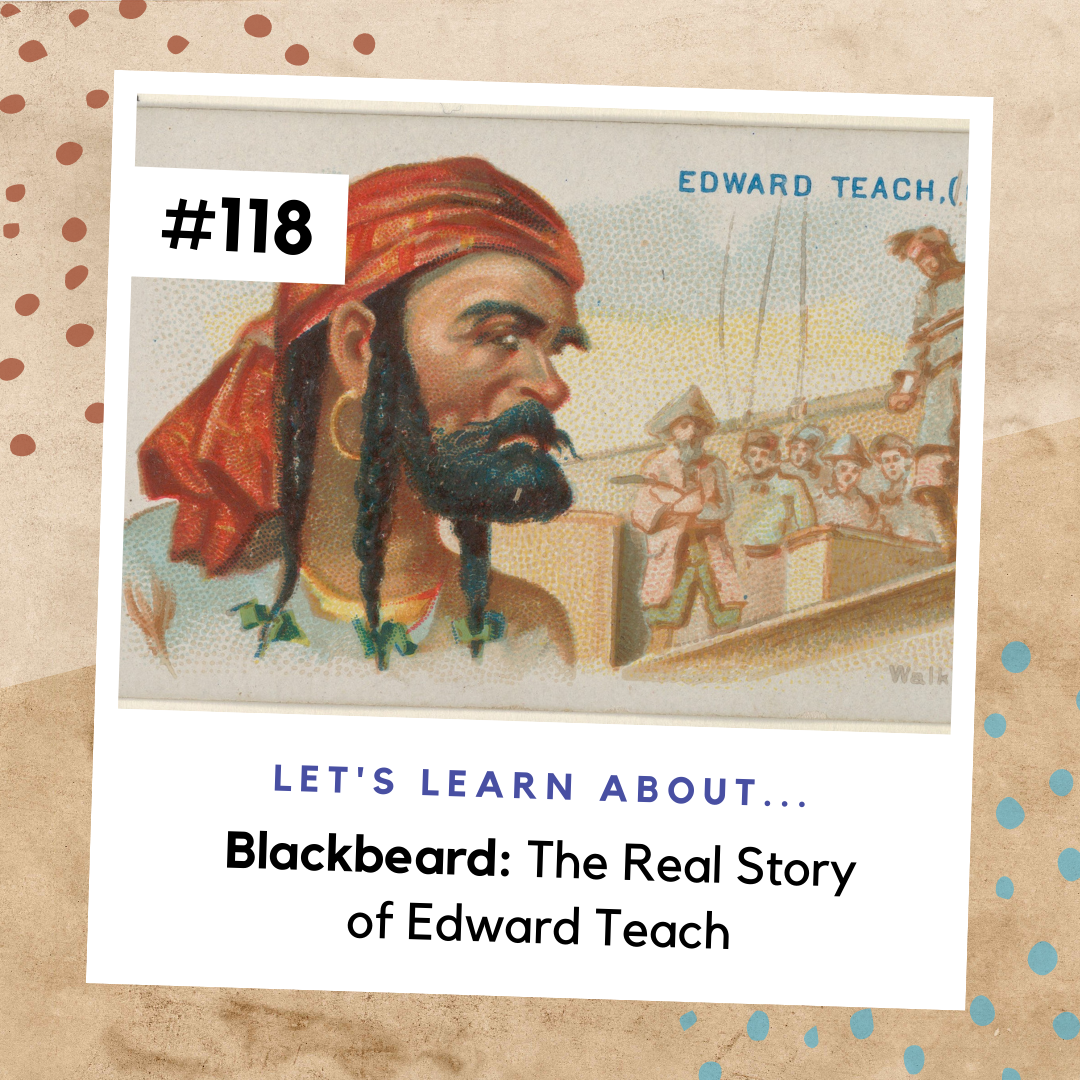
It is during this affidavit that the first recorded account of Teach's appearance was ever made and is the source of his famous nickname, Blackbeard – Bostock described Teach as a "tall spare man with a very black beard which he wore very long". Later descriptions mention that his thick black beard was braided into pigtails, sometimes tied in with small coloured ribbons.
It seems likely that Teach understood the value of appearances; better to strike fear into the heart of one's enemies, than rely on bluster alone. Teach was tall, with broad shoulders. He wore knee-length boots and dark clothing, topped with a wide hat and sometimes a long coat of brightly coloured silk or velvet. Further descriptions later described Teach in times of battle as wearing "a sling over his shoulders, with three brace of pistols, hanging in holsters like bandoliers; and stuck lighted slow matches under his hat", the latter apparently to emphasise the fearsome appearance he wished to present to his enemies. Despite his ferocious reputation, there are no verified accounts of his ever having murdered or harmed those he held captive. Teach may have used other aliases; on 30 November, the Monserrat Merchant encountered two ships and a sloop, commanded by a Captain Kentish and Captain Edwards (the latter a known alias of Stede Bonnet).
Enlargement of Teach's fleet
Teach's movements between late 1717 and early 1718 are not known. Henry Bostock’s claim about the pirates heading to Hispaniola turned out to be false, but he and Bonnet were believed to be responsible for an attack off Sint Eustatius in December 1717. Apart from French vessel that went down off the North side of Hispaniola that was rumoured to be at the hands of Blackbeard and Bonnet (although unconfirmed) Teach and his crew had vanished…
Until March 1718 that is! While taking on water at Turneffe Island east of Belize, both ships spotted the Jamaican logwood-cutting sloop Adventure making for the harbour. She was stopped, her captain invited to join the pirates, and Blackbeard promptly replaced him with another gentleman fans of OFMD might recognise - Israel Hands - as captain of the Adventure. Over the course of just 2 months Teach considerably enlarged his fleet, adding another ship and four sloops to their flotilla as they sailed between the Bay of Honduras, Grand Cayman, Havana, and the eastern coast of Florida. This of course is not including all the other vessels that they attacked and sank along the way…
Blockade of Charles Town
By May 1718, Teach had awarded himself the rank of Commodore and was at the height of his power. Late that month his flotilla blockaded the port of Charles Town in the Province of South Carolina - meaning all vessels entering or leaving the port were stopped - and as the town had no guard ship, its pilot boat was the first to be captured. Over the next five or six days about nine vessels were stopped and ransacked as they attempted to sail past Charles Town Bar, where Teach's fleet was anchored. One such ship, headed for London with a group of prominent Charles Town citizens which included Samuel Wragg (a member of the Council of the Province of Carolina), was the Crowley. Her passengers were questioned about the vessels still in port and then locked below decks for about half a day. Teach informed the prisoners that his fleet required medical supplies from the colonial government of South Carolina, and that if none were forthcoming, all prisoners would be executed, their heads sent to the Governor and all captured ships burnt.
Wragg agreed to Teach's demands, and a Mr. Marks and two pirates were given two days to collect the drugs. Teach moved his fleet, and the captured ships, to within about five or six leagues from land. Three days later a messenger, sent by Marks, returned to the fleet; Marks's boat had capsized and delayed their arrival in Charles Town. Teach granted a reprieve of two days, but still the party did not return. He then called a meeting of his fellow sailors and moved eight ships into the harbour, causing panic within the town. When Marks finally returned to the fleet, he explained what had happened. On his arrival he had presented the pirates' demands to the Governor and the drugs had been quickly gathered, but the two pirates sent to escort him had proved difficult to find; they had been busy drinking with friends and were finally discovered, drunk.
Teach kept to his side of the bargain and released the captured ships and his prisoners—albeit relieved of their valuables, including the fine clothing some had worn.
Pardon
Teach had at some stage learnt of the offer of a royal pardon and probably confided in Bonnet his willingness to accept it. The pardon was open to all pirates who surrendered on or before 5 September 1718, but contained a caveat stipulating that immunity was offered only against crimes committed before 5 January. Although in theory this left Bonnet and Teach at risk of being hanged for their actions at Charles Town Bar, most authorities could waive such conditions. Teach thought that Governor Charles Eden was a man he could trust, but to make sure, he waited to see what would happen to another captain. Bonnet left immediately on a small sailing boatfor Bath Town, where he surrendered to Governor Eden, and received his pardon.
Teach, meanwhile, used the time alone to his advantage. Along with Isreal Hands, on June 10 of 1718, he ran both the Queen Anne's Revenge and the Revenge aground on Beaufort Isle in North Carolina. Resources were transferred to Blackbeard's other ship The Adventure (the one helmed by Hands) and both ships was abandoned with much of its crew marooned. He then continued on to Bath, where in June 1718—only days after Bonnet had departed with his pardon—he and his much-reduced crew received their pardon from Governor Eden.
Bonnet, meanwhile, had travelled back to collect the Revenge and the remainder of his crew, but unfortunately for him, as well as marooning his crew, Teach had stripped the vessel of its valuables and provisions. Bonnet set out for revenge, but was unable to find him. He and his crew returned to piracy and were captured on 27 September 1718 at the mouth of the Cape Fear River. All but four were tried and hanged in Charles Town.
He settled in Bath, on the eastern side of Bath Creek at Plum Point, near Eden's home. During July and August he travelled between his base in the town and his sloop off Ocracoke. There are also rumours that he married the daughter of a local plantation owner, although there is no supporting evidence for this. Eden gave Teach permission to sail to St Thomas to seek a commission as a privateer (a useful way of removing bored and troublesome pirates from the small settlement) and Teach was given official title to his remaining sloop, which he renamed Adventure. By the end of August he had returned to piracy, and in the same month the Governor of Pennsylvania issued a warrant for his arrest, but by then Teach was probably operating in Delaware Bay, some distance away. He took two French ships leaving the Caribbean, moved one crew across to the other, and sailed the remaining ship back to Ocracoke. He lied and told Eden that he had actually found the French ship at sea, deserted.
Ocracoke Inlet was Teach's favourite anchorage, as it was a perfect vantage point from which to view ships travelling between the various settlements of northeast Carolina. It was from there that Teach first spotted the approaching ship of Charles Vane, another English pirate. Several months earlier Vane had rejected the pardon brought by Woodes Rogers and escaped the men-of-war the English captain brought with him to Nassau. He had also been pursued by Teach's old commander, Benjamin Hornigold, who was by then a pirate hunter. Teach and Vane spent several nights on the southern tip of Ocracoke Island, accompanied by such notorious figures as his friend Israel Hands, Robert Deal and Calico Jack.
Alexander Spotswood
The news of Teach and Vane's impromptu party worried the Governor of Virginia, Alexander Spotswood, who was concerned that the supposedly retired freebooter and his crew were living in nearby North Carolina. Some of Teach's former crew had already moved into several Virginian seaport towns, prompting Spotswood to issue a proclamation requiring all former pirates to make themselves known to the authorities, to give up their arms and to not travel in groups larger than three. Although Spotswood had no legal authority to have pirates tried, it didn’t stop him from arresting Teach’s former quartermaster to try and find out from him where Teach whereabouts were – to the Governor, Teach’s presence was a crisis.
And it worked too - Spotswood managed to obtain valuable information on Teach's whereabouts on Ocracoke Island from the quartermaster, and he planned to send his forces across the border into North Carolina to capture him. Spotswood personally financed the operation, possibly believing that Teach had fabulous treasures hidden away, and ordered a Lieutenant Robert Maynard, now in command of two commandeered sloops, to approach from the sea.
Last battle
Maynard’s forces departed Williamsburg on Nov. 17, 1718, and sailed down the James River. Although Maynard would have preferred to have the services of a British man-of-war to take on the fearsome pirate, such a ship could not navigate the shallow waters of Pamlico Sound, so Maynard had to rely on the services of two small sloops, the Ranger and the slightly larger Jane, with 25 men placed on the former, 35 on the latter, which would be the vessel on which Maynard sailed. While these sloops could easily navigate the shallow and twisting channels around Ocracoke, they had no cannons, which meant that Maynard’s men would have to rely on their personal weapons in going up against a foe with, according to their records, nine cannons at his disposal.
By the afternoon of Nov. 21, Maynard’s sloops had reached the southern tip of Ocracoke. They soon spied two sloops at anchor in an inlet facing Pamlico Sound, which to this day is known as Teach’s (or Thatch’s) Hole. With evening coming on, Maynard anchored the Jane and the Ranger for the night.
Unaware of the force amassed nearby, Blackbeard, along with about 20 of his men on board the sloop Adventure, spent that evening drinking and carousing with local trader Samuel Odell, who had arrived earlier on his own sloop. The following morning, the sea was calm and the winds very light, and the only sounds to be heard were birds greeting the break of day. At nine, Maynard ordered the Ranger to make way for the sloops, still not certain that one of them was Blackbeard’s. The Jane followed close behind. Not long after setting out, the Jane grounded, and then the Ranger did the same. Men on the Jane began furiously throwing heavy materials overboard to lighten its load, while the Ranger’s crew staved their water casks to the same end. Both sloops were soon afloat again, but that precious element of surprise had been lost.
Even if they had been in drunken stupors, Blackbeard’s men would have been alerted by all the nearby commotion. Realizing that he was under attack, Blackbeard ordered his men to cut the Adventure’s cable and get underway. To intimidate their attackers, the pirates began shooting at the approaching sloops. It appeared that Blackbeard’s plan was to head out of the channel that the sloops had just entered by engaging them in a running battle. As Blackbeard tried to reach the channel’s mouth, the Ranger headed straight for the Adventure, with the Jane right behind, its men straining at their oars to close in.
When the Jane pulled to within about half a pistol shot of the Adventure, there was a brief conversation between Maynard and Blackbeard. According to a second-hand account in the Boston News-Letter, the exchange was as follows:
Teach called to Lieutenant Maynard and told him he was for King George, desiring him to hoist out his boat and come aboard. Maynard replied that he designed to come aboard with his sloop as soon as he could, and Teach, understanding his design, told him that if he would let him alone, he would not meddle with him; Maynard answered that it was him he wanted, and that he would have him dead or alive, else it would cost him his life; whereupon Teach called for a glass of wine, and swore damnation to himself if he either took or gave quarter.
Maynard’s own account of the conversation is similar, but briefer, and makes one wish that the naval officer had not been so laconic. “At our first salutation,” Maynard wrote, Blackbeard “drank damnation to me and my men, whom he styled sniveling puppies, saying, he would neither give nor take quarter.”
As soon as the talking was over, Blackbeard took full advantage of his superior firepower and unleashed a booming broadside of partridge and swan shot that killed the commander of the Ranger and severely wounded five of his men, including the second and third in command. Shorn of its officers, the Ranger fell behind and was not a factor until the very end of the battle. The broadside also wounded many men on the Jane, but they continued to fight. In an amazing display of marksmanship, or, more likely, a lucky shot, they severed the Adventure’s jib halyard, the line holding the jib — a triangular sail — up, which caused the sail to collapse and thus slowed the vessel down. Not wanting to expose any more of his men to blasts from Blackbeard’s cannons, Maynard ordered all of them below decks, while he went into the cabin at the stern of the ship. Maynard was not only retreating to get out of harm’s way, but he was also setting a trap. Before going to the cabin, Maynard ordered the pilot and a midshipman to stay on deck and alert him as to what Blackbeard was doing. If it worked out as Maynard hoped, the pirates would soon come to him.
Seeing that the Jane’s decks were clear, Blackbeard thought that his cannons had done their deadly work, and the battle was all but won. To deliver the coup de grâce, Blackbeard brought the Adventure alongside the Jane and led his men over the rails, with a rope in his hand to lash the vessels together. As soon as Blackbeard was aboard, the pilot signaled Maynard, who, along with 12 of his men, rushed to the main deck, catching the pirates off guard. During the six-minute melee that ensued, the combatants slashed, thrust, and shot at one another at close range, their grunts, screams, and groans intermingled with the sounds of clashing steel and exploding gunpowder.
When the smoke finally cleared, the great Blackbeard lay dead, and the rest of his men who had followed him onto the Jane were either killed or severely wounded. At about the same time, the Ranger arrived, and its men boarded the Adventure and beat the remaining pirates into submission. Pirates who lost their nerve and jumped overboard, rather than fight to the end, were shot in the water as they tried to escape. None of them survived, and one corpse was found in the reed’s days later, with buzzards circling overhead.
According to Maynard, none of his men on the Jane were killed during the fight, but many of them were “miserably cut and mangled.” Although various accounts disagree on the numbers, overall, approximately ten navy sailors and ten pirates died, and more than 20 sailors were wounded. Maynard took nine pirates’ prisoner.
One of the men wounded on the Adventure was trader Odell, the man who had visited Blackbeard to celebrate but was caught up in the battle. Although Odell fought with the pirates, Maynard and his men owed him a debt of gratitude, for if it had not been for his quick thinking, the death toll off Ocracoke that day would have been much higher. Before the fighting started, Blackbeard instructed one of his crew, a man named Caesar, to blow up the ship in the event that the pirates were defeated. Caesar was in the hold, ready to light the ammunitions magazine, when Odell and one of his crewmen wrestled the flame out of his hand.
The death of Blackbeard is one of the most famous events in the history of piracy. Not surprisingly, the exact way in which he was killed is the subject of debate. Whilst colourful second-hand accounts of Blackbeard’s final moments made their way to the enraptured public, all Maynard had to say about Blackbeard’s demise is that “he fell with five shot in him, and twenty dismal cuts in several parts of his body.” Maynard added, “I have cut Blackbeard’s head off, which I have put on my bowsprit, in order to carry it to Virginia.” Blackbeard’s headless body was pitched into the murky water of Pamlico Sound, where, according to legend, it took a few laps around the Jane before sinking out of sight.
On Jan. 3, 1719, under sunny skies, the victorious Maynard sailed up the James River aboard the Adventure, with Blackbeard’s decomposing and no doubt pungent head hung from the bowsprit. As a warning to those who might consider piracy a profitable career, Virginia Governor Spotswood had Blackbeard’s head mounted on a pike at the entrance of Chesapeake Bay — a location later christened Blackbeard’s Point – where it stood for several years.
According to some later accounts, Blackbeard’s head was eventually taken down, and the top half of his skull was turned into a punch bowl that was “enlarged with silver, or silver plated,” and used for a time at one of the taverns in Williamsburg. If this in fact is true, the grisly artefact is lost, for it has not turned up since.
And what of his famous ship? Well, the wreck of the Queen Anne’s Revenge was actually discovered off the coast of North Carolina by divers in the mid-1990s. Hundreds of artifacts were recovered from the site in the following decades, including navigational devices, cannons, and a sword hilt.
Sign up to receive email updates
Enter your name and email address below and I'll send you periodic updates about the podcast.
Support us on