
7 National Trust Properties That Have an LGBTQ+ History (#107)
LISTEN TO THIS EPISODE
Listen to or download this episode right here on this page, or find more places to listen below.
More Places to Listen
(Listening on Apple Podcasts or Spotify? Please leave us a quick star rating and/or review - it'd mean a lot!)
About the Episode
What is more British than the National Trust? And whilst we celebrate pride month during July on this podcast, in the UK it’s actually celebrated in February. So why not celebrate them both in one episode?!
Ellie talks about 7 National Trust properties that were once owned and loved by prominent LGBTQ+ figures throughout history, including Vita Sackville-West and Virginia Woolf.
Related episode: 6 Historic Queer People Everyone Should Learn About (#91)
Links & Resources
- An unconventional couple: Vita Sackville-West and Harold Nicolson | National Trust
- Henry Cyril Paget, the Dancing Marquess | National Trust
- Smallhythe Place: a creative ménage à trois | National Trust
- The home and refuge of Lawrence of Arabia | National Trust
- William John Bankes and his life in exile | National Trust
- Bucks Mills Cabin | National Trust
- Why does LGBTQ heritage matter? | National Trust
- Our LGBTQ podcast series presented by Clare Balding | National Trust
- Virginia Woolf: defying expectation | National Trust
Full Episode Notes
If you can’t listen to the episode for accessibility reasons, or you just want to refer to the notes as you listen, you can find the full in-depth notes for this episode below.
7 National Trust Properties That Have an LGBTQ+ History (#107)
What is more British than the National Trust? And whilst we celebrate pride month during July on this podcast, in the UK it’s actually celebrated in February. So why not celebrate them both in one episode?
In 2017 broadcaster and author Clare Balding presented a new six-part podcast series (LINK IN THE NOTES!), exploring the lost and hidden LGBTQ stories from our places to mark the 50th anniversary of the partial de-criminalisation of homosexuality.
Over six 20-minute episodes, Clare explores how lesbian, gay, bisexual, trans and queer people have helped to shape and preserve the houses, collections, gardens and landscapes in our care.
In each episode Clare examines new themes including women’s relationships, the importance of secluded spaces for LGBTQ+ artists, attitudes to sexuality in the ancient and classical world and connections with the performing arts.
Sissinghurst Castle Garden, Kent
The writer Vita Sackville-West always felt she belonged at her lavish ancestral home: Knole, in Kent. She was distraught that as a woman, she couldn't inherit it.
When she married the diplomat Harold Nicolson, though, they found another historic place in the weald of Kent: Sissinghurst Castle, a magnificent collection of Tudor buildings and a sprawling farm, all of which had long been neglected. Vita and Harold bought it in 1930 and dedicated the following years to making it their home.
Vita and Harold formed a genuinely loving partnership and a marriage that lasted until Vita's death in 1962. Yet their letters and biographies reveal that both Vita and Harold had numerous same-sex relationships during their life together. On Vita’s part this included some very serious relationships – most famously, those with Violet Trefusis and Virginia Woolf.
Their marriage was the foundation of their life together, offering both constancy and freedom for them both to pursue their same-sex desires.
Vita and Harold transformed the grounds at Sissinghurst into the spectacular gardens which now attract thousands of visitors every year.
It was a labour of love, which Vita and Harold planned together down to the finest detail. The legacy of their work surrounds you when you visit, from the meticulous planting and unfolding garden 'rooms' to the heady, romantic rose garden.
Clouds Hill, Dorset
When T. E. Lawrence first bought Clouds Hill, it was a rough and ready bolt hole. Lawrence chose the cottage, in part, as a place where he could escape his new-found celebrity. During the First World War, he had served as a military and intelligence officer in the Middle East. He had since earned a great deal of attention and accolades for his achievements. The public’s imagination was fuelled by media stories of his heroism and romanticised images of him in Arab dress.
When he found the cottage, he was working in a tank corps under the pseudonym Private T.E. Shaw. Lawrence began renovating the cottage, following Arts and Crafts principles, from 1922, to make it his main home.
He found Clouds Hill a secluded and restful home and wrote a number of books here. But he also entertained many friends from the worlds of literature and the visual arts including Thomas Hardy, George Bernard Shaw, Augustus John, Siegfried Sassoon and E.M. Forster.
Lawrence had an enigmatic public persona. He had worked to support the political cause of Arab self-determination in the First World War and was enchanted by the attractions of young Arab men. Homosexual experiences were hinted at in his writing. He dedicated his most famous work The Seven Pillars of Wisdom (1926) to Dahoum Ahmed, a young man with whom he had had a close and intimate friendship during his pre-war years in Syria.
Plas Newydd, Wales
Henry Cyril Paget, the Dancing Marquess, was considered the 'black sheep' of the family for his eccentric behaviour and love of performance and costume, but he was undeterred. In his short life (1875 - 1905), his love of theatre and performance lead him to tour the country and transform the chapel at Plas Newydd into a theatre. Surviving photographs show Henry in costume, sometimes cross-dressing, with a confident gaze at the camera. He earned his nickname 'the dancing Marquess' for the sinuous dance he gave at his performances.
To be accepted by his peers, Henry was expected to dress conservatively, marry, have children, and live what would be considered a respectable life for a man of his status. But Henry was never cowed by the expectations of Victorian society. As the 5th Marquess of Anglesey, Henry had grown up accustomed to great wealth. Over the years, he indulged his passion for clothes and jewellery and amassed an astonishing collection of haute couture clothes and costumes.
Henry inherited Plas Newydd, the family seat, in 1898. He then converted the family chapel into an ornate, 150 seat theatre, which he named the Gaiety. He performed there regularly with his theatre company and invited the local people from Anglesey to attend performances free of charge. He also toured Europe with his company and performed plays by Oscar Wilde – a bold move since Wilde had been jailed for 'obscenity'.
Henry's private life has been subject to speculation over the years. There is no evidence of Henry having same-sex relationships, but his brief marriage was annulled and recorded as 'unconsummated'.
When Henry died at just 29 years old, he had already lived a full and adventurous life. His spendthrift habits caught up with him however, and his possessions were sold in the 'forty-day sale'. The auction listed hundreds and hundreds of items, from silk dressing gowns to fur coats. The photographs that survive of Henry, however, show his love of costume and performance and remind us of his vivacious spirit.
Monk's House, Sussex
The author Virginia Woolf was a leading light of the Bloomsbury movement in the early 20th Century, a group of artists and intellectuals with a bohemian approach to love and sexuality. In her writing, Virginia forged a playful, imaginative style that threw off the conventions of the time. In her personal life, she was just as controversial.
Virginia was happily married to Leonard Woolf for almost thirty years, but also had an intense affair with another writer, Vita Sackville-West. Virginia's love of Vita inspired the novel Orlando, (1928), which imagines Vita (as Orlando) living through centuries, shifting gender and commenting on the changing assumptions about love, marriage and women’s role over time. Orlando’s ancestral home is based on Knole, Vita’s family home, and expresses her attachment to the place.
Monk's House was the beloved home of Virginia and Leonard Woolf, and it's filled with collections from their shared life. Many writers and artists also visited the house, and Virginia frequently recorded them in photographs. You can see some on display in the Writing Lodge, the evocative room tucked away in the garden where Virginia wrote many of her most famous books.
Virginia Woolf's novels are now part of the most important works of modern English literature. Her books reveal her profound skill as a writer as well as her broad-ranging, fluid approach to life. To Virginia, and the Bloomsbury group she was part of, gender and sexuality were not made up of a simple, confining set of rules. They were a malleable, shifting spectrum of experiences. It was a bold view which helped to challenge some of the stifling expectations of society.
Smallhythe Place, Kent
Tucked away in the weald of Kent is a quintessentially English home. But the Tudor beams and rambling roses disguise a deeper truth: Smallhythe Place was also a vibrant, radical place filled with creative spirits and pioneering women.
The famous Victorian actor Ellen Terry bought the sixteenth-century farmhouse in 1899. She gave the use of another house in the grounds – Priest's House – to her daughter Edy and Edy's female partner, Chris St John. They were later joined by the artist Tony Atwood (originally called Clare), and their relationships lasted the rest of their lives. It was important to them all as a loving home, but Edy also transformed Smallhythe into a lively and pioneering place for women and the arts.
Edy Craig followed her mother into the theatre, working most often as a producer and costume designer. She was also a committed suffrage feminist in the years before the First World War, when Smallhythe became a haven for many other activists. Edy founded and managed the Pioneer Players for almost fifteen years from 1911. It was a theatre society that staged many innovative plays in London and produced some 150 plays for the suffrage movement.
In the same defiant spirit, Edy created a home life that embodied her own values. She shared a home with writer and translator Christopher St John from 1899. In 1916 the artist Tony (Clare) Atwood joined them and they lived in a ménage à trois for many years, each supporting the others in their relationship and their creative endeavours. They were part of a lesbian network who were drawn to Smallhythe as a place that offered freedom of expression in art, gender and sexuality.
Smallhythe was visited by many other queer women, such as Virginia Woolf, and her lover Vita Sackville-West, who lived at nearby at Sissinghurst. Chris St John, like many women, was quickly mesmerised by Vita, and recorded her intense feelings in her diary.
Edy Craig was the most important figure in preserving Smallhythe Place for future generations. When her mother Ellen Terry died, she made the house into a museum in her memory. She also converted the barn into a theatre which hosted many famous figures both on the stage and in the audience. Few places offer such immersion in the world of the theatre and queer history.
Kingston Lacey, Dorset
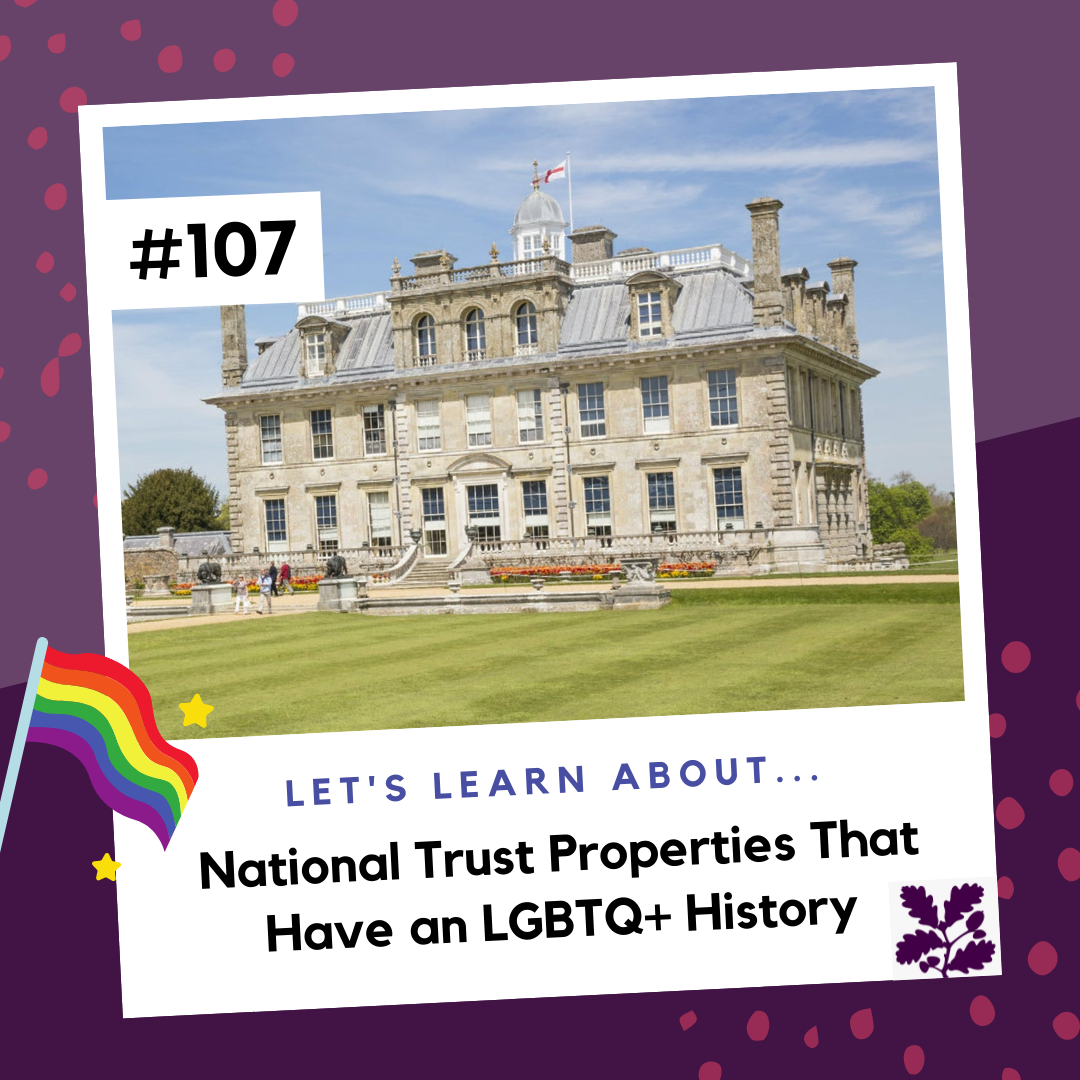
Kingston Lacy is a grand country manor and estate in Dorset. The scale and significance of its collections are the work of generations of the Bankes family, particularly William John Bankes (1786–1855). His devotion to Kingston Lacy never wavered, even when he was forced into exile over his homosexuality.
Bankes remodelled the house at Kingston Lacy in the 1830s, and had it encased in Chilmark stone. His eye for detail, love of art and his own talent as a draughtsman were evident throughout his life. He travelled widely, often sketching the places he visited, and he always sought to expand his knowledge of art. His expert eye had a great influence on the collections at Kingston Lacy, from an exceptional store of ancient Egyptian artefacts to the masterful paintings and sculptures that are on display.
Developing Kingston Lacy was a life-long passion for Bankes. Sadly, he could never fully be himself; he was gay yet had to keep his homosexuality a secret. Homosexual acts between men were deemed a criminal offence, punishable by death.
In 1833, Bankes narrowly escaped punishment, having been charged with 'an unnatural offence', meaning physical relations with another man. It was only thanks to the influence of his powerful family and friends that he was not charged.
In 1841, Bankes was again charged for taking part in an 'indecent act', and this time he moved abroad to escape the charges. Leaving Kingston Lacy, the home he loved, was heart-wrenching. But we know from surviving letters that he continued to oversee the transformation of Kingston Lacy into a Venetian-style palazzo while exiled in France, and later Italy, until his death in Venice in 1855.
It's thought that Bankes risked his life to visit Kingston Lacy at least once before his death. In one of his letters home, he references a minute detail on one of the doors and asks for it to be fixed. Such a detail could only have been seen in person.
What's certain is that Bankes' enduring love of Kingston Lacy has enriched and preserved its outstanding collection, which we can still enjoy today.
The Cabin, Buck Mills
Perched above the sea in the ancient fishing hamlet of Bucks Mills, the Cabin was the studio and summer residence of painters Judith Ackland and Mary Stella Edwards from the 1920s until Judith's death in 1971. The interior and its contents have remained preserved, almost as the women left them, for over 40 years.
The Cabin looks almost exactly as Judith Ackland and Mary Stella Edwards left it over 40 years ago. You can step through the green door into another world filled with delicate china, a wood burning stove and old cupboards stuffed with bric a brac, all bathed in a wonderful natural light.
Judith Ackland and Mary Stella Edwards travelled widely on their painting trips, but Bucks Mills remained the place they loved the most. The two women spent most summers in Bucks Mills, painting coastal scenes, local landscapes and the village.
Judith Ackland (1892-1971) was born at Stowford House on Bideford Strand. Her father was a well-known doctor, and from an early age she would accompany him on visits to treat his patients at Bucks Mills. She attended Bideford School of Art before going to the Regent Street Polytechnic in London where she met Mary.
In 1945, Judith invented a method of making tiny figurines from cotton wool, naming her process 'Jackanda'. She would make figures and objects for dioramas with backdrops painted by Mary Stella. The subjects for the dioramas were often historical, and this collaboration brought many successful commissions including five dioramas which are on permanent display at the Windsor Guildhall.
Mary Stella Edwards (1898 - 1989) chose to paint in watercolours like Judith, but she was also a published poet and considered herself a poet first and painter second. Her poetry is filled with references to the sea and the sounds of the beach. She was born in Hampstead, where her father was an architect.
The Burton Gallery in Bideford holds a large collection of drawings, watercolours and dioramas featuring local subjects which were given to the gallery by Mary Stella Edwards. The Burton collection clearly shows the women's love of North Devon and of their Cabin in particular.
After Judith died in 1971, Mary Stella never used her seaside studio again, but set up the Ackland and Edwards Trust to look after the property. The Cabin was gifted to the National Trust in 2008.
Recently Bucks Mills Cabin has been used as a space for artist’s residencies. Unfortunately due to popular demand we are now at capacity for artist's residencies until 2024.
Sign up to receive email updates
Enter your name and email address below and I'll send you periodic updates about the podcast.
Support us on